The Places
Here is some background information about the principal places visited in the story. The illustrations shown are all taken from the book.
Exmouth
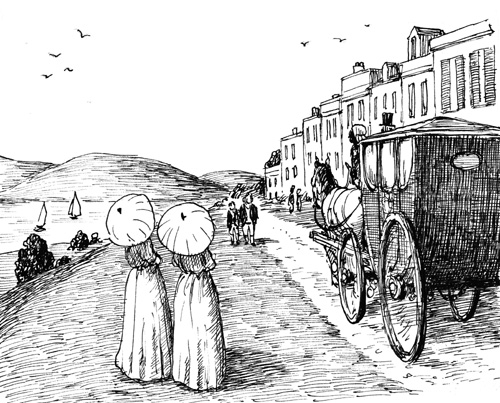 Exmouth was Devon's first seaside resort. In 1750 Bishop Pococke wrote that the little town was 'a place to which the people of Exeter much resort for diversion and bathing in the sea'.
In the years after the French Revolution (1789), travel to France became dangerous and after war broke out with France in 1793 it became impossible. Exmouth then expanded, as people of wealth and fortune began to holiday in South Devon instead of taking their usual holiday in the South of France. Work started in 1791 on Beacon Terrace (shown in the illustration), a prestigious row of houses commanding a fine view of the estuary.
|
Honiton
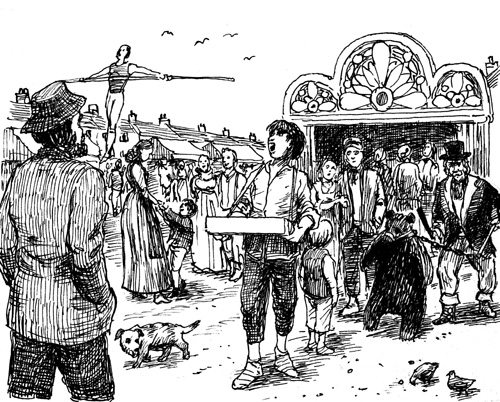 Honiton was an important market town and a staging point on the busy coach route from London to Exeter and Plymouth. The town was famous for its lace. This industry had been introduced by Flemish immigrants in the time of Queen Elizabeth I. Lace was produced by hand in local homes.
Honiton's charter fair dates from 1221 and it drew in big crowds from all the surrounding area. To mark the opening of the fair, the town crier carried a twelve-foot pole along the street with a leather glove on the top. He proclaimed that no one could be arrested while 'the glove was up'.
|
Lynton and Lynmouth
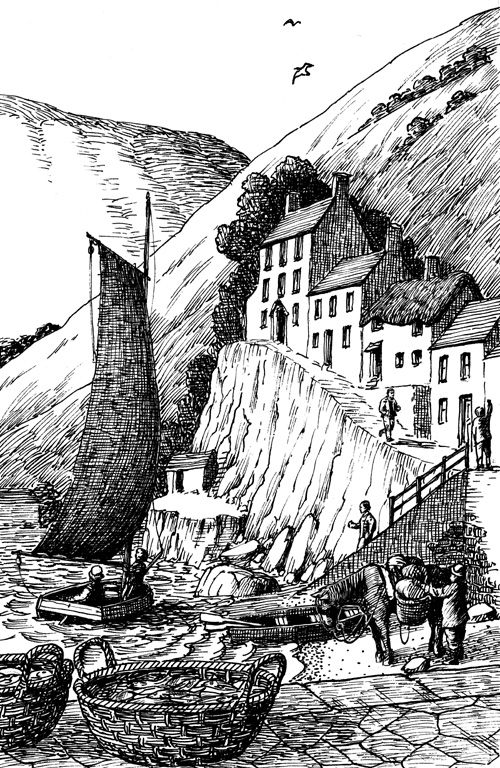 Lynton is situated at the top of a 450-foot-high cliff on the Exmoor coast. In 1803 it was a small farming village. Some of the women spun the wool from local sheep, but the wool trade had been badly damaged by the war with France.
Lynmouth was a fishing village crouched at the bottom of the cliffs, but the herring shoals suddenly disappeared from the Bristol Channel at the end of the eighteenth century and the inhabitants faced great hardship. On Christmas Day, 1811, a great shoal did enter Lynmouth Bay and the church service was brought to an abrupt end so the fishermen could take to their boats.
There were no proper roads to the twin villages, but by 1803 a few tourists were beginning to make the difficult journey over Exmoor, drawn there by reports of the spectacular scenery and also of a stone circle in the Valley of Rocks.
|
Parracombe
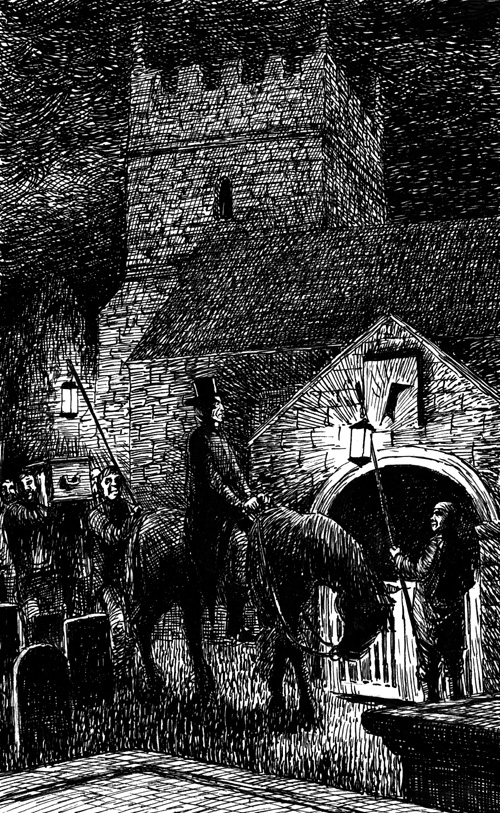 Parracombe was a small farming village some five miles south-west of Lynton. It lay tucked away in the Heddon Valley in what was then a remote part of Exmoor. Most of the surrounding uplands were then unimproved common land.
The medieval church of St Petrock (which features in the story), stands on a hillside away from the village. A new church was built closer to the centre of the village in 1879 and St Petrock's is now a redundant church in the care of the Churches Conservation Trust.
|
Sidmouth
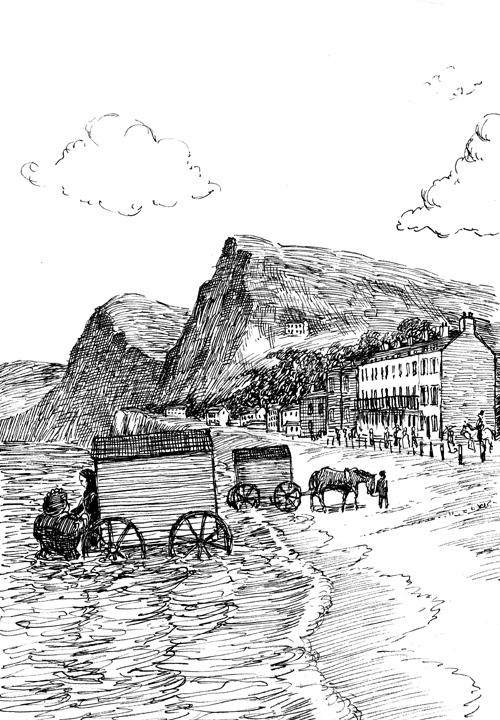 The first reference to tourism at Sidmouth came in 1776 when it was said to be playing host to 'company resorting hither for the benefit of bathing and drinking the waters'. This reference to 'drinking the waters' is interesting. In the eighteenth century wealthy visitors were accustomed to drink the mineral waters at the spas for their health so when they began to arrive at the seaside resorts they drank seawater in exactly the same way.
Sidmouth was another Devon resort to benefit from the closure of the Continent to British tourists, following the outbreak of war with France in 1793. It developed a reputation as a health resort with a mild air, said to be like that of the South of France. Sidmouth claimed the invalid could there 'inhale those breezes which so frequently suspend the ravage of disease'. Trade boomed and in 1805 it was reported: 'A great number of new houses have been erected ... ranged upon the beach'.
|
Teignmouth
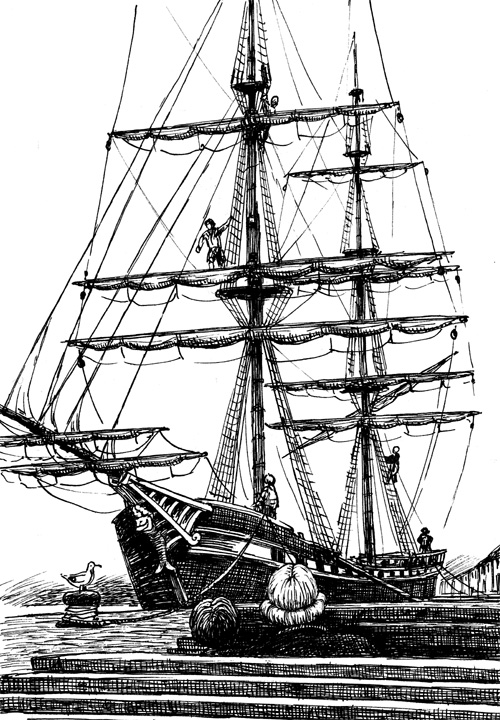 Teignmouth had long been an important centre of the Newfoundland cod trade. By 1759 it was also beginning to attract a few holidaymakers and it was reported that it was 'being visited both for health and recreation'.
In 1762 the Royal Magazine advised its readers that at Teignmouth: 'For the sake of drinking that fashionable purging draught, seawater, and bathing, for which purpose two machines were lately constructed, numbers of people from all parts resort here in the summer season, and cripples frequently recover the use of their limbs, hysterical ladies their spirits and even the lepers are cleansed'.
Tourism boomed in the years after the outbreak of war with France in 1793. In October 1799 a local banker wrote: 'Teignmouth is still full of company and enquiries are made daily for purchasing building plots ... people are absolutely building mad'.
|
Torquay
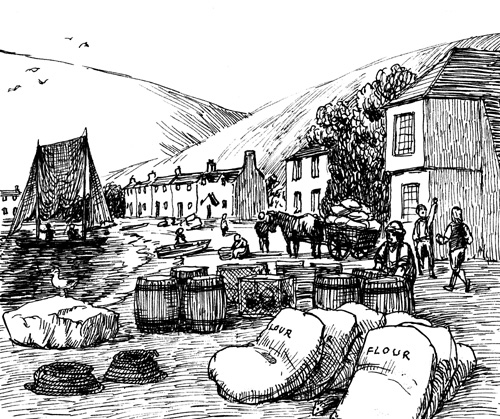 Torquay in 1803 was still only a small fishing village, but a few visitors were beginning to arrive, lured by reports that its mild climate was beneficial for health. In that year a guidebook advised that 'the invalid also may rest assured of finding the lodgings and accommodations good for a place yet in its infant state'.
Naval officers were also beginning to rent the fishermen's cottages, so they had somewhere ashore to stay when the Channel Fleet returned from blockading Brest to take on fresh supplies in Tor Bay.
|